
The Problem: Your Marketing Reports Look Great. But Are You Signing More Clients?
Ever thought about dropping thousands of dollars each month on Google Ads or Meta Ads?
Your agency says leads are up, your cost-per-lead is down, and your campaigns are better than ever!
But on the ground, when you track new clients on retainer, the growth doesn’t seem as strong.
This is a universal issue in legal marketing.
More leads don’t always result in more paying customers.
One campaign might bring you 100 inquiries; a different campaign, 30. But if the bulk of the 100 inquiries are irrelevant, not in your target market, unqualified, or they don’t go any further than that first call, then what’s the value in those numbers?
The issue is that most ad platforms only track success until someone fills out a form or makes a call.
And that’s when a law firm should start thinking about landing clients.
Our Solution: Track the Retainer, Not Just the Lead
Lawagenz drives more leads to you by combining the intake process with your lead generation strategy.
Instead of just listing how many inquiries each campaign received, we track what happens next.
Were the questions response-worthy? Did they pick up the phone? Did they make an appointment? Did they show up? More importantly, did they sign a retainer?
By tracking these outcomes and attributing them to the original marketing source, we can see which campaigns generate real opportunities for the firm.
This means we can further optimize targeting, adjust ad spend, and measure success based on clients gained, not leads.
How the Process Works
Marketing Campaign → New Enquiry → Lead Qualification → Consultation → Signed Retainer → Campaign Optimization
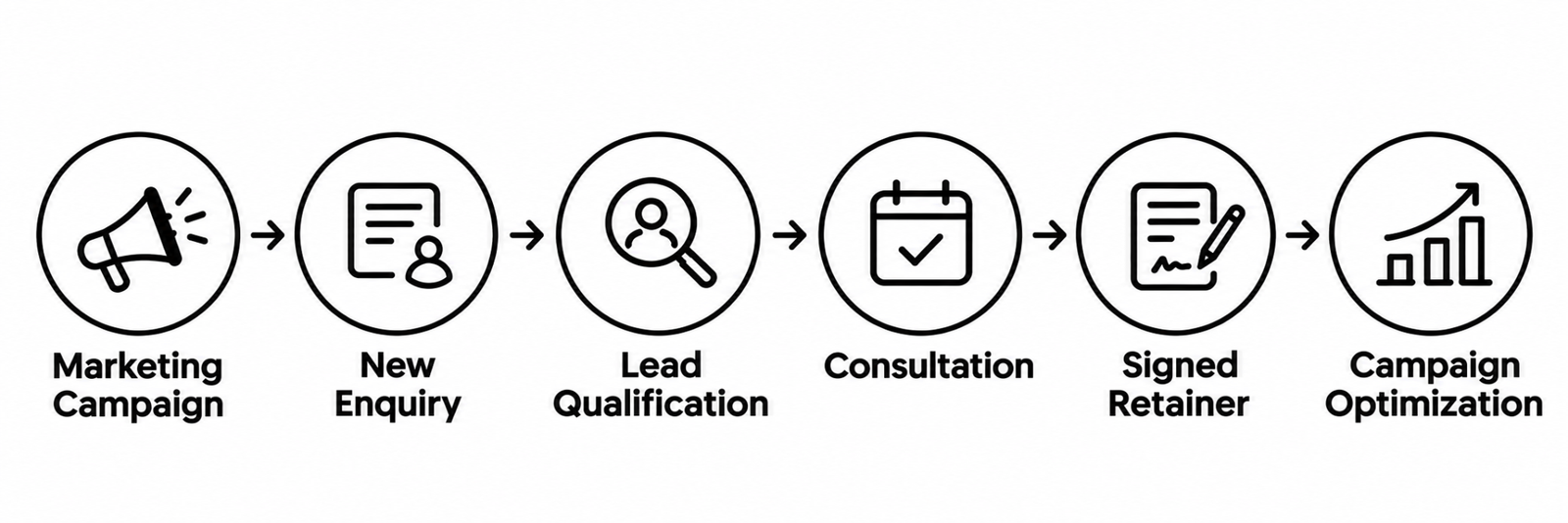
It’s a straightforward idea: follow the lead until you know what happened, then use that information to improve the marketing.
Inside Our Lead-Tracking System: Resolve Legal Group
For Resolve Legal Group, we utilized a reporting process to track inquiries that come in beyond the initial contact form or phone call.
By hosting the metrics in one system rather than two (lead gen + intake results), the tracker offers insight into the business’s most critical phases.
Screenshot 1: The Lead Tracking Dashboard
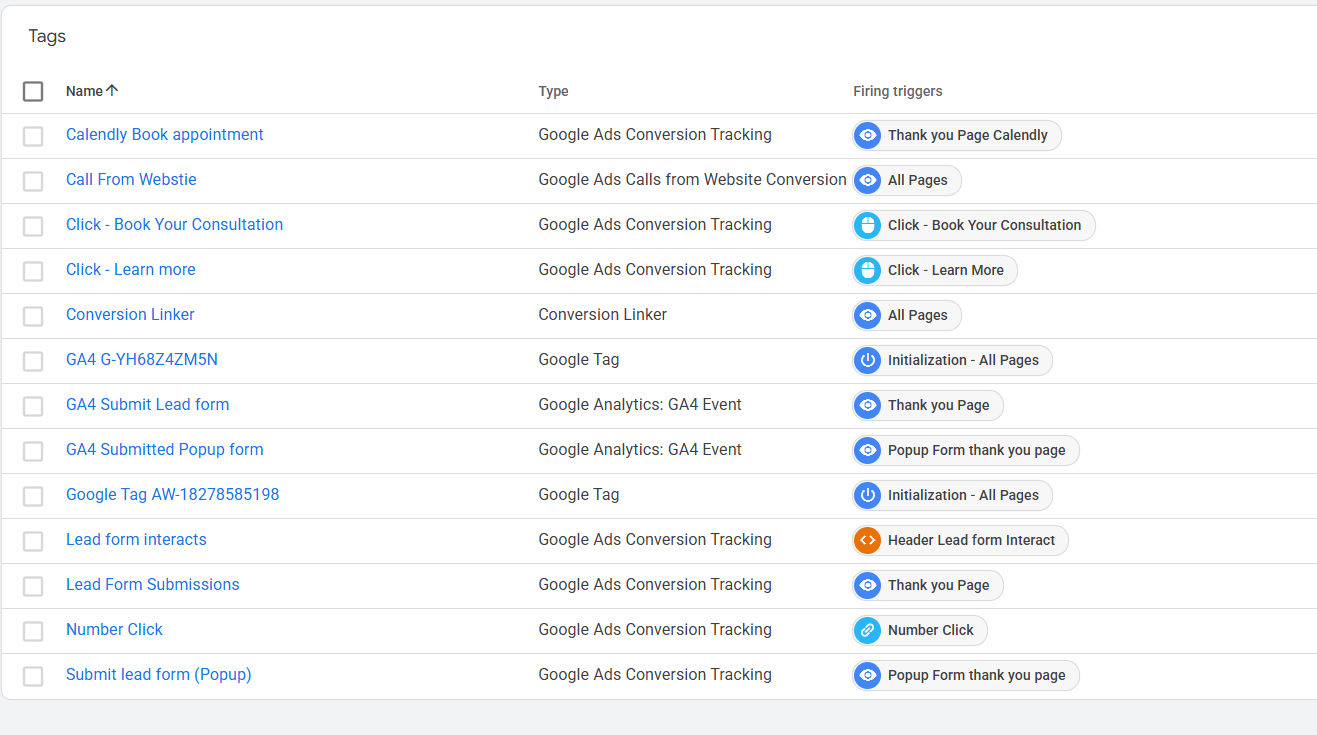
Caption: Our lead-tracking system records new inquiries, their relevance, follow-up progress, consultation bookings, and final outcomes.
This lets us see more than just the overall volume of submissions.
For instance, the report lets us differentiate between a relevant prospect, a client who needs a specific service, and a consultation booking.
Screenshot 2: Following Leads Through the Intake Process
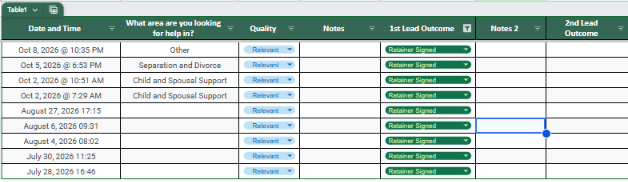
Caption: By following inquiries through the intake process, we can identify which leads progressed toward becoming retained clients.
The Resolve Legal Group tracker includes 9 recorded retainer-signed entries during the supplied reporting period, including nine website enquiry entries and four call entries.
These records provide insight into actual outcomes beyond initial lead generation. The figures are tracker entries and should be reconciled before being treated as unique signed clients.
Screenshot 3: Identifying Leads That Don’t Convert
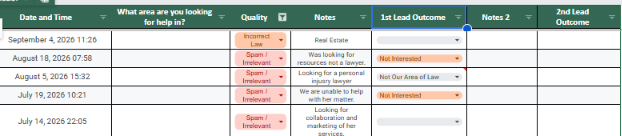
Caption: Tracking unsuccessful enquiries is as important as tracking signed retainers because it helps you identify where you’re losing potential clients.
The goal isn’t to eliminate every unsuccessful enquiry. It’s to understand patterns.
If certain sources consistently produce irrelevant leads, you may need to improve targeting. If qualified enquiries regularly go unanswered or aren’t followed up, the problem may happen after the advertisement.
This is where reporting helps you make real business decisions.
The Difference Between More Leads and More Clients
Consider two advertising campaigns with the same monthly budget.
Metric | Campaign A | Campaign B |
Advertising Spend | $2,000 | $2,000 |
Leads Generated | 80 | 30 |
Cost Per Lead | $25 | $66.67 |
Signed Retainers | 2 | 6 |
Cost Per Signed Retainer | $1,000 | $333.33 |
Illustrative comparison, not actual Resolve Legal Group performance data.
Based on cost per lead alone, Campaign A would seem to be the winner.
The number of enquiries is doubled at the second-lowest cost.
But Campaign B generates three times as many signed retainers for the same investment.
The lower-leads campaign gets more clients.
Hence, cost per lead is just one element.
What matters is how much the firm pays to get a customer who will pay.
The Process: How We Connect Marketing to Signed Retainers
With the tracking system in place, we can see how well the overall client acquisition process works.
Here’s how that works.
1. Know the Source of Each Lead
It starts with someone reaching out to the company.
Based on the tracking configuration that is set up, we get:
- Marketing platforms such as Google Ads, Meta Ads or organic search.
- Campaign and relevant tracking parameters.
- Lead submission method (website form, phone, etc).
- Date of enquiry.
- Available campaign or click identifiers.
This information attaches an ad interaction to a brand new enquiry.
For instance, two people might contact the company for the same legal service through separate campaigns.
That distinction lets us measure how each source performs.
2. Determine Whether the Lead Is Actually Qualified
An enquiry is not necessarily a qualified potential client.
Legal ads can bring in people looking for a free consultation, those needing services the firm doesn’t offer, or lawyers outside our service area.
So, the next step is lead qualification.
Check through the intake outcomes to ensure the enquiry is a valid opportunity in relation to the practice area.
This prevents a campaign from paying for a high volume of low-quality enquiries.
3. Monitor Appointment Follow-up and Scheduling
A qualified lead does not mean a converted client.
Contacting prospects is painful. Others book a consultation but never follow through. And some are close to going with your firm but then choose another.
By capturing these results, we can identify where potential learners drop out of the acquisition process.
For example, if the campaign provides relevant enquiries but only a small number of consultations, the problem may be late lead response or the removal of the enquiry to the firm.
That is a long way from a campaign that produces mostly worthless enquiries.
Each problem requires a different response.
4. Attach Signed Retainers to the Underlying Document
This is the most important stage.
Once a prospect signs a retainer, refer it back to the enquiry.
With good source and campaign IDs, we can trace that retained client back to the advertising activity that brought them in initially.
So, we can compare campaigns against other metrics, not just form submissions.
Instead of saying:
“Campaign A had 60 leads. Campaign B had 25.”
We can evaluate:
“Was there more qualified consultations, signed retainers, or value to the firm from either campaign for its dollar spent on advertising?”
The difference is significant.
It changes how we evaluate campaign performance.
5. Use Signed-Retainer Data to Optimize Advertising
As we gather clear conversion metrics, we leverage those insights to continuously optimize marketing campaigns.
That could translate to:
Refine ad targeting: Stop burning your budget on audience segments or keywords that consistently deliver poor-quality inquiries.
Reallocate marketing spend: Shift funds toward high-converting campaigns that yield actual retained clients, rather than blindly scaling campaigns that simply offer cheap leads.
Sharpen messaging and eligibility criteria: Clarify your service offerings up front to discourage irrelevant inquiries and save valuable intake time.
Uncover intake bottlenecks: Determine whether qualified prospects are falling through the cracks, experiencing delayed follow-ups, or failing to convert after consultations.
Evaluate real return on investment: Measure cost per signed retainer and calculate actual return on ad spend using verified revenue numbers.
These optimizations rely on tracked performance data, accounting for standard reporting delays, attribution windows, and confirmed client conversions.
What This Means for a Law Firm
Traditional advertising reports only show surface-level metrics like clicks, phone calls, or form submissions.
Our reporting process goes deeper to tackle the questions that actually impact your bottom line.
Which marketing channels deliver genuinely relevant prospects? Which leads successfully transition into booked consultations? At what points in the intake process are potential clients dropping off? And most importantly, which ad campaigns drive verified, signed retainers?
With these insights, your firm can make smarter decisions about ad spend.
Scaling overall lead volume shouldn’t be the primary objective.
The real goal is to attract higher-quality inquiries and improve the proportion of prospects that ultimately become retained clients.
The Outcome: A Clearer Picture of Marketing Performance
For Resolve Legal Group, the reporting process monitors inquiry types, lead qualification, consultation progress, and signed retainers within a single unified system.
During this period, the tracking system recorded 13 signed retainer outcomes along with complete intake metrics covering both successful and unsuccessful leads.
This comprehensive view lets the practice track the full trajectory of inquiries as they move through the acquisition process.
When full attribution details are available, these records link retained client outcomes directly back to the original advertising source.
Ultimately, this approach provides a far clearer picture of marketing performance, allowing campaigns to be judged on real business growth rather than raw conversion counts on ad dashboards.
How do we do it: Marketing should be about how many clients you garner from your efforts
At LawAgenz, we recognize that an initial form submission is only the starting point, not a guarantee of success.
For any legal practice, the primary objective remains securing paying clients.
That’s why we track the entire journey from the initial ad click to the signed retainer.
Focusing on a smaller pool of highly qualified prospects delivers significantly better returns than handling high lead counts that fail to convert.
While additional inquiries are helpful, driving verified retained clients is what truly scales a law practice.
Stop Guessing Which Campaigns Are Working
Your marketing reports generate a lot of leads, but you have no way of knowing which campaigns convert into clients. That’s one of the most important pieces of your marketing performance.
We guide law firms to build marketing and tracking systems centred on real client conversion results.
Schedule Your Free Law Firm Growth Strategy Call.
Discover the places where your marketing is actually working to bring in new business, where you’re leaking sales, and how to optimize your advertising spend.