SEO for law firmsdepends on several factors, including your practice area, region, competition, website condition, and project scope. Competition in a target market can also shape the SEO strategy and required resources. A good SEO investment for law firms should consider several factors.
Key Takeaways
Lawyer SEO costs depend on competition, location, specialty, website quality, and campaign size.
A lawyer’s SEO campaign helps build a long-term organic presence on web pages without per-click charges.
Google Ads for lawyers can deliver faster visibility, while SEO builds sustainable organic growth.
SEO and paid advertising can work together as part of a broader law firm marketing strategy.
Measure SEO ROI for law firms through qualified inquiries, consultations, and new clients – not traffic alone.
SEO Pricing for Law Firms in Ontario – What Is the Cost?
There are many factors that affect law firm SEO pricing, which include, among others, the location of the firm, the legal specialties that the firm practices, the competitiveness, the existing state of the law firm’s website, content needs, technical SEO, local SEO, and the need for link building.
For example, SEO costs for lawyers in Ontario can vary widely, depending on the firm’s business volume, target geography, competition, and marketing needs. On average, SEO services might cost between CAD $1,500 and $10,000 permonth, with larger, more competitive law firms requiring higher investment. This depends on the scope of services and their growth goals.
These figures are indicative estimates rather than fixed rates. Actual pricing varies by agency, deliverables, business size, competitive landscape, and campaign requirements.
Thus, the key question is not only about “how much does SEO cost,” but also about the appropriate “what level of SEO spending is right for me?”
What Does Law Firm SEO Pricing Usually Include?
Investing in an SEO project for a law firm entails far more than simple keyword ranking. A total SEO plan could consist of:
* Keyword research & Search Intent analysis
* Optimization of practice area pages
* Technical SEO
* Content Development & Optimization
* Internal Linking
* Local SEO for law firms/Google My Business Optimization
* Citations & Authority building
* Competitor Analysis
* Conversion Tracking & Reporting
Your initial investment may also include website improvements. It may require significant technical improvements, content development, a redesign, or structural changes. These strengthen the foundation supporting both organic search and other digital marketing activities.
SEO vs. Google Ads for Lawyers: Understanding the Cost
Google Ads for lawyers and SEO are two different ways to get found.
Google Ads offer instant visibility because firms pay to appear when someone searches for specific keywords. This is useful when a firm wants inquiries right away. At the same time, the firm pays for each click.
SEO works differently. Instead of paying for every organic visit, you invest in improving your website, content, technical foundation, local presence, and authority.
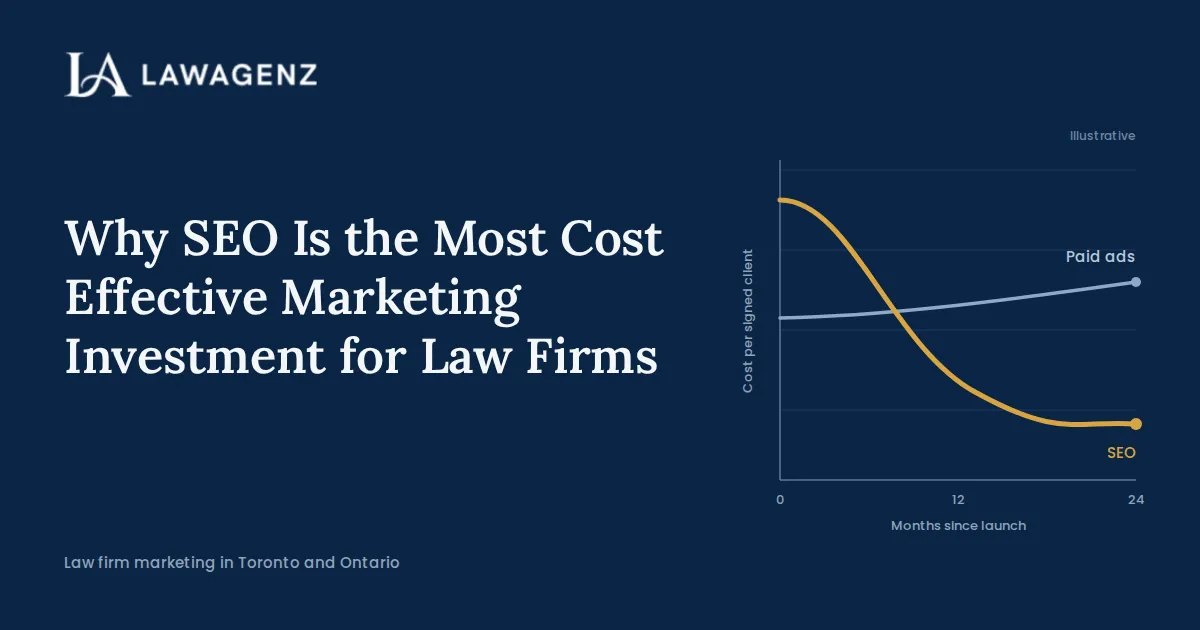
The key difference is what happens over time. When a paid campaign stops, the paid traffic stops with it. SEO can keep generating organic visibility from pages and content already developed.
Why SEO for Law Firms Can Deliver Greater Long-Term Value
SEO’s long-term value for law firms comes from organic visibility that builds over time.
A well-optimized practice area page can continue attracting relevant searches. A useful legal guide can answer prospective clients’ questions months after publication. Strong local SEO can support visibility for location-based searches.
This doesn’t mean SEO leads to immediate success. Many factors, like competition, website authority, content quality, technical issues, and more, determine how visible your search results are. But consistent work builds an organic search asset, not just ad spend.
For firms with a long-term growth strategy, SEO can become increasingly cost-effective as organic visibility and qualified traffic grow.
Where Does Law Firm Marketing ROI Come From?
Law firm marketing ROI should ultimately connect to business outcomes, not traffic alone.
Measures that will be helpful for a law firm are the following:
* Quality organic inquiries
* Calls
* Requests for consultation
* Contact form submission
* Organic leads per practice area
* Local search ranking
* Conversion rate
* New clients via organic search
For example, ranking for a highly relevant search such as personal injury lawyer in Toronto may be more valuable to a personal injury firm than receiving thousands of visits from people looking for general legal information.
This is why SEO ROI for law firms should focus on the quality and commercial value of leads generated—not simply the number of website visitors.
How Local SEO for Law Firms Can Improve Marketing Efficiency
Legal services are often location-specific. Prospective clients often search for lawyers in a specific city, neighborhood, or region.
A strong local SEO strategy for law firms includes optimizing your website’s location signals, practice-area pages, local citations, reviews, and Google Business Profile.
This can help your firm compete for local-intent searches and connect with people more likely to need your services in your target market.
For a firm serving Toronto, for example, focusing on relevant Toronto legal searches can be more valuable than targeting broad national terms that may generate less qualified traffic.
How to Decide the Right SEO Investment for Your Firm
The right SEO budget depends on your firm’s objectives, market, and growth goals, not a fixed industry price.
Your Practice Area
Highly competitive areas such as personal injury, immigration, and criminal defense may require greater investment because more firms compete for the same searches.
Your Location
Competition can vary significantly between smaller communities and major markets such as Toronto.
Your Current Website
A technically strong website with established authority may require a different investment from a new or underdeveloped website.
Your Growth Goals
A firm targeting one practice area and location may require a different strategy from a multi-location firm promoting several legal services.
Your Measurement Strategy
Your agency should connect SEO activity with meaningful actions such as calls, inquiries, consultation requests, and new-client opportunities.
SEO as a Long-Term Marketing Asset+
Consider the cost of SEO for lawyers versus the long-term gains organic search can deliver.
Unlike advertising, which directly correlates visibility with media spend, SEO builds an asset through optimized web pages, useful content, technical improvements, local visibility, and authority.
Conclusion
Beyond being an ongoing monthly marketing cost, SEO is a long-term investment that will enhance your law firm’s online presence, credibility, and search potential.
SEO pricing for Ontario law firms varies by location, specialization, competition, and your website’s condition. Instead of focusing on price, consider whether your SEO is generating legitimate leads, consultations, and business growth.
At LawAgenz, we help law firms build their online presence with digital marketing strategies tailored to their practice area, market niche, and objectives. When considering an SEO solution for your firm, know where you stand in terms of performance.
A great lawyer can still struggle to bring in new clients.
You may have years of legal experience, strong case results, satisfied clients, and an impressive reputation. Yet your phone may stay quiet when someone searches Google for a lawyer in your area.
That can be frustrating.
Many law firms face the same problem. Referrals bring business, but they are unpredictable. A website exists, but it generates very few enquiries. Social media takes time without producing obvious results. Paid advertising can become expensive when the wrong people click. And even after investing in SEO, it can be difficult to understand why competitors appear above your firm.
These problems all point to the same issue: having a good law practice is not enough if potential clients cannot find it.
Law firm marketing helps bridge that gap.
It gives your firm a structured way to become visible when people are searching for legal help, understand what those potential clients need, communicate why your firm is relevant, and turn online attention into genuine consultations.
But effective legal marketing is not about publishing random blog posts or buying advertisements and hoping for the best. It requires a strategy built around your practice areas, target clients, location, competition, budget, reputation, and long-term growth goals.
So, what exactly does law firm marketing involve, and how can a firm use it to attract better-quality cases?
What Is Law Firm Marketing?
Law firm marketing is the process of promoting a legal practice, building its visibility, attracting potential clients, and creating opportunities for new consultations through online and offline channels.
The objective is not simply to generate more website traffic.
A successful marketing strategy should help a firm attract the right people with the right legal needs at the right stage of their decision-making process.
For example, someone searching “what is a separation agreement?” may still be researching.
Someone searching “family lawyer for separation near me” is likely much closer to contacting a lawyer.
Understanding this difference allows a firm to build marketing around client intent, rather than treating every website visitor as equally valuable.
Why Is Marketing Important for a Law Firm?
A law firm can have an excellent reputation and still lose potential clients to competitors with stronger online visibility.
Think about what happens when someone needs legal help.
They may search Google, compare several law firms, read reviews, visit websites, check practice areas, look at lawyer profiles, and eventually contact one or two firms.
If your firm is absent during that process, another firm gets the opportunity.
Law firm marketing is important because it helps your practice:
Become easier to discover
Reach potential clients earlier
Build credibility before the first consultation
Generate more relevant enquiries
Reduce dependence on referrals
Compete in crowded legal markets
Strengthen visibility for specific practice areas
Create a predictable client acquisition system
The biggest benefit is not simply “more traffic.”
It is more opportunities to be considered by people who are actively looking for legal assistance.
How Does Law Firm Marketing Work?
Effective legal marketing usually follows a continuous cycle rather than a one-time campaign.
1. Research
The first step is understanding the market.
A firm needs to know:
Who its ideal clients are
What legal problems they have
What they search for online
Which competitors appear in search results
Which practice areas have the strongest demand
Which locations the firm serves
What competitors are doing successfully
Where existing marketing is failing
Without research, firms can spend months targeting keywords or audiences that produce little business value.
2. Strategy
Research should then be turned into a marketing strategy.
This may involve selecting priority practice areas, defining geographic targets, creating content topics, deciding between organic and paid channels, and establishing measurable goals.
For example, an immigration lawyer may prioritize searches related to specific immigration services rather than attempting to rank for the extremely broad term “immigration lawyer.”
3. Implementation
The strategy is then put into action.
This could include improving the website, publishing useful content, optimizing local listings, launching paid campaigns, creating landing pages, improving internal linking, or strengthening online authority.
4. Measurement and Improvement
Marketing does not end after implementation.
Firms need to evaluate:
Search visibility
Organic traffic
Lead volume
Consultation requests
Phone calls
Conversion rates
Advertising costs
Lead quality
Cost per qualified case
The information gathered should then be used to improve the strategy.
What Are the Main Types of Law Firm Marketing?
There is no single marketing channel that works for every legal practice.
Different approaches serve different purposes.
Search Engine Optimization
SEO helps a law firm’s website appear when potential clients search for relevant legal services.
A personal injury firm, for example, may want visibility for searches related to accident claims, injury compensation, or personal injury representation.
SEO can involve:
Technical optimization
Practice-area pages
Location pages
Educational content
Internal linking
Local SEO
Authority building
Website performance
Search intent analysis
The goal is to create useful pages that genuinely satisfy what searchers are trying to accomplish.
Local SEO
Local visibility matters enormously for lawyers because many clients want representation in a particular geographic area.
Someone may search:
family lawyer near me
criminal lawyer in Toronto
employment lawyer in Ontario
divorce lawyer near me
A strong local SEO strategy helps a firm become more visible for geographically relevant searches.
This involves more than simply adding a city name to a page.
Factors can include business information consistency, Google Business Profile optimization, reviews, local relevance, location-specific content, links, and overall website authority.
Google Ads and PPC
Paid search allows firms to appear prominently for selected searches without waiting for organic rankings to develop.
This can be useful for high-intent searches where a potential client is already looking for legal assistance.
However, PPC can become expensive quickly.
A campaign may receive clicks without producing qualified consultations if keywords, targeting, landing pages, messaging, and conversion tracking are poorly aligned.
That is why successful legal PPC requires more than simply increasing an advertising budget.
Content Marketing
Legal content can answer questions potential clients have before they contact a lawyer.
Examples include:
What happens after a car accident?
How does the divorce process work?
What are the consequences of a criminal charge?
How long does an employment dispute take?
What documents are needed for an immigration application?
When should someone speak to an estate lawyer?
Useful content can introduce a firm to potential clients earlier in their decision-making process.
Social Media Marketing
Social platforms can help lawyers demonstrate knowledge, communicate with their audience, share educational information, and strengthen brand familiarity.
The goal should not necessarily be to make every post go viral.
For a professional service such as legal representation, consistent credibility can be more valuable than temporary attention.
Email Marketing
Email can help firms stay connected with people who are not ready to contact them immediately.
For example, someone may download a legal guide, subscribe to updates, or visit a website while still considering their options.
A useful email strategy can keep the firm visible until the person is ready to take the next step.
A law firm’s website can create useful content for different stages of that journey.
This creates more opportunities to appear when a potential client moves from research toward action.
How Should a Law Firm Optimize Its Website?
Your website is often one of the first places a potential client evaluates your firm.
Unfortunately, many legal websites focus heavily on the firm’s credentials while providing too little information about the client’s actual problem.
A stronger website should make several things immediately clear:
What type of legal help you provide
Who you help
Where you operate
Why someone should consider your firm
What happens next
How to contact you
Practice-area pages should explain the service clearly rather than simply listing legal terminology.
Lawyer profile pages should establish relevant expertise and credibility.
Contact pages should make taking the next step simple.
And the website should work well on mobile devices, since many prospective clients search from smartphones.
What Makes Legal Content More Useful?
Good legal content should answer the question behind the search.
Suppose someone searches:
“How long does a divorce take?”
A weak article might repeat the phrase throughout a page.
A useful article would explain:
What factors influence the timeline
What type of divorce is involved
What can cause delays
What documents may be required
What steps are typically involved
When professional legal advice may be useful
This approach is valuable for users and search systems because the content actually resolves the underlying question.
For legal topics, accuracy is especially important.
Content should avoid exaggerated promises, unsupported claims, misleading statements, and information presented as universally applicable when legal requirements can differ by jurisdiction.
How Can Law Firms Improve Their Visibility in AI Search?
Search is changing.
Potential clients are increasingly receiving synthesized answers from AI-powered search experiences instead of relying exclusively on traditional blue-link results.
That creates a new challenge for law firms.
A firm may rank reasonably well but still have limited visibility if its content does not clearly answer the questions being asked.
AI-friendly content should therefore be:
Clear
Well organized
Factually accurate
Comprehensive
Original
Easy to understand
Supported by credible information
Structured around genuine user questions
For example, instead of creating one generic page about employment law, a firm could answer closely related questions such as:
What does an employment lawyer do?
When should someone speak to an employment lawyer?
What can an employment lawyer help with?
How much does an employment lawyer cost?
What should someone bring to an employment consultation?
What happens during an employment law consultation?
Each section should provide a direct answer before expanding on the subject.
This creates useful, self-contained information that can satisfy different search journeys.
Google’s current guidance for generative AI search emphasizes creating unique, valuable content for users rather than attempting to write content specifically for an AI system.
What Are Common Law Firm Marketing Mistakes?
Many marketing problems come from strategy rather than effort.
Targeting Only Broad Keywords
A firm may spend months trying to rank for an extremely competitive term while overlooking more specific searches that could generate qualified enquiries.
Publishing Content Without a Purpose
Publishing dozens of generic articles does not automatically create authority or clients.
Each piece should have a clear audience, search intent, and reason for existing.
Ignoring Local Search
A law firm can have a strong website and still miss valuable local opportunities if its local presence is neglected.
Focusing on Traffic Instead of Leads
High traffic numbers can look impressive while producing very little business.
The quality of enquiries matters.
Sending Paid Traffic to Weak Pages
Getting someone to click an advertisement is only the first step.
If the landing page is confusing, slow, generic, or disconnected from the advertisement, potential clients may leave without contacting the firm.
Expecting Immediate SEO Results
Organic search generally requires patience.
Competitive legal searches can take significant time to improve, particularly when a firm is starting with limited authority.
Treating Marketing as a One-Time Project
Search behavior changes. Competitors change. Algorithms change. Practice priorities change.
Marketing therefore needs continuous evaluation.
How Much Should a Law Firm Spend on Marketing?
There is no universal marketing budget that works for every law firm.
A reasonable investment depends on factors such as:
Firm size
Practice area
Geographic market
Competition
Client value
Current website performance
Existing search visibility
Advertising costs
Growth objectives
A firm should evaluate marketing based on business outcomes rather than simply asking, “How much should we spend?”
A better question is:
“What level of investment can produce a sustainable number of qualified clients at an acceptable acquisition cost?”
That changes the conversation from spending to return.
How Long Does Law Firm Marketing Take to Work?
The timeline depends heavily on the channel.
Paid advertising can generate visibility quickly once campaigns are active, but results depend on targeting, competition, budget, landing-page quality, and lead conversion.
SEO generally takes longer because websites need to establish relevance, authority, and trust.
Content marketing can also take time to build momentum.
This is why law firm marketing should be treated as a long-term growth system rather than a quick fix for an empty pipeline.
The firms that benefit most are usually those that continuously test, measure, improve, and build on what works.
What Should a Law Firm Do If Referrals Are No Longer Enough?
Referrals remain valuable.
But depending entirely on referrals can create an unpredictable growth cycle.
One month may be busy.
The next may be slow.
A firm may also find itself unable to control how many people are introduced through its existing network.
Digital marketing provides another acquisition channel.
A potential client who has never heard of the firm can discover it through Google, local search, paid advertising, educational content, social media, or another online touchpoint.
The objective is not to replace referrals.
It is to create additional, controllable ways for potential clients to discover the practice.
What Is the Best Marketing Strategy for a Law Firm?
There is no single strategy that is automatically best for every firm.
The right approach depends on the firm’s:
Practice areas
Location
Competition
Ideal clients
Budget
Current online authority
Growth goals
Client acquisition economics
For many firms, a combination of SEO, local visibility, high-intent paid search, useful content, conversion optimization, and reputation building can create a stronger acquisition system than relying on one channel alone.
The most effective strategy is the one that consistently connects the firm with qualified people and turns that visibility into meaningful consultations.
For law firms looking to build that kind of focused digital growth strategy, LawAgenz brings together legal-industry-specific marketing expertise across search, paid media, local visibility, content, and AI-focused optimization.
LawAgenz Insights
Stay Ahead In Legal Marketing.
Get practical strategies, industry insights and growth ideas designed specifically for law firms delivered straight to your inbox.
No spam. Just useful legal marketing insights.
Exclusive Lawyer Growth Program
Advocate for your clients. We will bring them to you.
Direct high-value legal leads straight to your firm.